
Ask ten business owners how they get customers online and you’ll probably hear two answers: “we’re working on SEO” or “we run Google Ads.” Ask them which one is actually better and the room goes quiet. That’s why the SEO vs Google Ads question comes up so often. Both put you in front of people who are already searching, but they behave very differently once you start spending money and time on them.
There’s no single winner. What works for a dentist opening a second clinic won’t suit a wholesaler with a six-month sales cycle. Your goals, your advertising budget and how soon you need enquiries all change the answer. So here’s how The Bharat Solutions looks at it, and how you can build a digital marketing strategy around the channel (or mix of channels) that fits your situation.
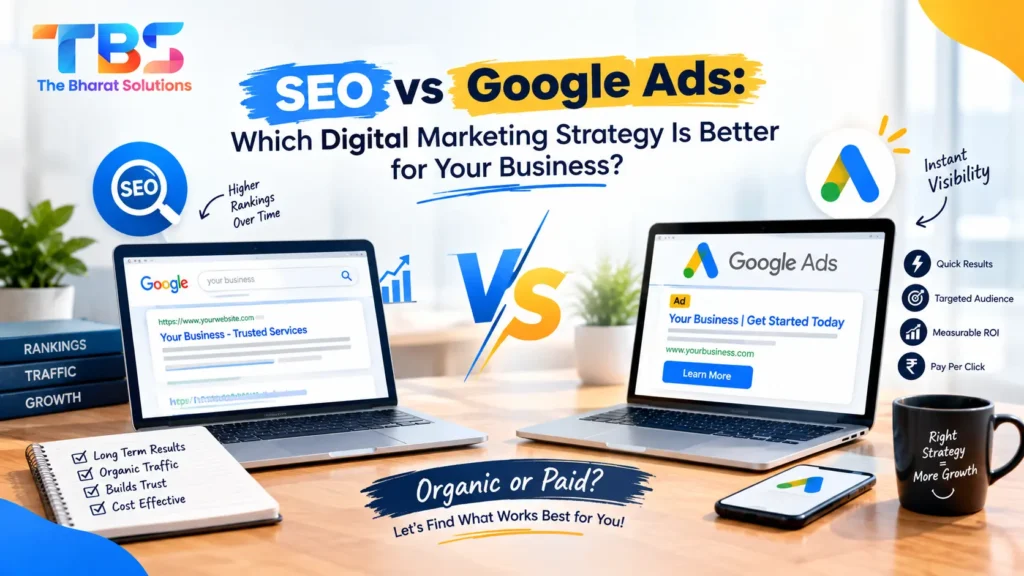
What SEO Actually Does for Your Website
SEO, or search engine optimisation, is the work of making your website easier for Google to understand and more useful for the people who land on it. Do it well and your pages climb the unpaid results. Those organic search rankings are what bring in visitors without a per-click fee.
In practice, SEO is a handful of jobs done together. Someone has to research keyword targeting, meaning the exact phrases your customers type into Google, and shape pages around them. Someone has to fix slow load times, broken links and mobile layout problems. Someone has to write content that answers real questions better than the pages already ranking. And over time, you need other reputable sites to mention or link to you. Good SEO services pull all of this into one ongoing plan, because skipping any piece usually shows up in the results.
The payoff is stronger search engine visibility and a steady flow of website traffic from people who were already looking for what you sell.
Benefits of SEO
The biggest draw is staying power. A well-built page can keep bringing in visitors for months, even years, which is why SEO is closely tied to long-term digital growth. Cost per visit tends to fall as pages gain traction, since you’re not paying for each click. People also tend to trust organic listings more than ads, which can make a lead warmer by the time it reaches you.
Where SEO Falls Short
Be realistic about the downsides. SEO is slow. Several months is normal before you see real movement, and competitive industries take longer. It also never really finishes, since content ages, competitors improve and Google updates its algorithms. And nobody can promise you a specific ranking, so be wary of anyone who does.
How Google Ads Works and Why Paid Search Campaigns Bring Quick Enquiries
Google Ads is the platform behind the sponsored results you see at the top of a search page. You pick the keywords you want to appear for, write the ad, set a budget and, in most search campaigns, pay only when someone clicks.
The big appeal is speed. Paid search campaigns can be live within days, and you decide who sees them: by location, device, time of day or search intent. A plumber can show ads only within ten kilometres of the workshop, only during working hours. That kind of control is hard to match anywhere else.
Running it properly takes more than switching it on. Solid Google Ads services cover keyword research, ad copy, landing page suggestions, bid management and conversion tracking, so you can tell which clicks turned into calls or sales and which ones just burned money.
Benefits of Google Ads
You get visibility almost immediately, precise targeting and numbers you can actually measure, from clicks to cost per lead. Budgets are flexible too. You can start small, see what happens, then scale up or pull back.
The Catch with Google Ads
The catch is simple: when the money stops, the traffic stops. Popular keywords can get expensive, a weak landing page can quietly waste a big part of your spend, and campaigns need regular attention to stay efficient.
SEO vs Google Ads: How They Compare on Cost, Speed, Traffic, Leads, Sustainability and ROI
People who search for SEO vs PPC are usually trying to compare six things, so let’s go through them one by one.
Cost. SEO asks for steady investment in content, technical fixes and optimisation, but there’s no bill for each visit. Google Ads has a more predictable short-term cost, though every click is charged and busy keywords can push prices up.
Speed. Ads can send visitors within days. SEO usually needs a few months before the effect is noticeable.
Traffic. Paid traffic switches on and off with your budget. Organic traffic builds gradually and keeps going as long as your pages stay relevant.
Lead generation. Ads are good at catching people who are ready to act right now. SEO works earlier and later: it reaches people who are still researching and keeps feeding lead generation long after a campaign period ends.
Sustainability. SEO assets, like a strong guide or service page, hold their value over time. Ads only perform while you pay for them.
ROI. Google Ads is easier to measure quickly, which helps when you need to justify spend. SEO tends to pay back more slowly but can compound. Either way, judge return on investment (ROI) by the leads and sales you actually get, not by clicks or rankings alone.
The old paid advertising vs organic traffic argument really comes down to time versus control. Ads give you control now. Organic gives you something that lasts.
When to Choose SEO, Google Ads or Both
Go with SEO if...
SEO makes sense if you’re building something for the long haul, your customers research before they buy, or you’d like to depend less on paid clicks over time. Those are the benefits of SEO that matter most to businesses with a longer horizon.
Go with Google Ads if...
Ads are the better starting point for a launch, a seasonal offer or any situation where waiting six months isn’t an option. They’re also a handy way to test which keywords and messages convert before you commit to writing content. For many owners, those quick wins are the benefits of Google Ads worth paying for.
Use both if...
For most growing businesses, honestly, it’s both. The SEO vs PPC choice is rarely either-or. A combined digital marketing strategy lets ads bring in enquiries now while SEO builds the base for later, and the keyword data from your ads can tell you what content to write next.
Real-World Examples for Small and Growing Businesses
Take a local home-services business with a tight advertising budget. It could run Google Ads only in its service area to get calls this month, and slowly improve its website and Google Business Profile so local searches work in its favour next year.
A new online store has no audience yet. Paid search campaigns can show which products people actually click and buy, and those results can shape the category pages and blog posts that earn organic traffic later.
A growing B2B company with a long sales cycle might publish detailed guides and case studies for lead generation at the research stage, while running tight ads on a few high-intent searches.
None of these choices is locked in. The SEO vs Google Ads balance can shift as budgets and results change.
How The Bharat Solutions Can Help
Choosing a mix is easier with someone to talk it through. The Bharat Solutions works with businesses on SEO services, Google Ads management and overall digital marketing planning, with the aim of finding a mix that fits your goals and budget.
If you’re searching for an SEO company in Ahmedabad or a Google Ads agency in Ahmedabad, the first conversation usually covers where your website stands today and what deserves attention first.
With SEO services, that can mean a website and keyword review, keyword targeting, on-page and technical improvements and content planning to support your organic search rankings. With Google Ads services, it can mean campaign setup, conversion tracking and ongoing optimisation so your advertising budget goes further. Reporting ties it together, showing website traffic, leads and costs in one place.
Every industry behaves differently, so advice depends on your competition, your website and your budget. Expectations are kept realistic, which means no promises of guaranteed rankings, leads or revenue.
Frequently Asked Questions
1. SEO vs Google Ads: which is better for a new business?
Neither wins automatically. If you need enquiries quickly, Google Ads can help. If you’re building for later, SEO matters. Plenty of new businesses start with a small paid budget and add SEO as they can afford it.
2. How much do SEO and Google Ads cost?
It depends on your industry, location, competition and the amount of work involved. With Google Ads you choose a monthly budget, and what each click costs depends on how competitive your keywords are. SEO is normally a monthly fee based on the scope of work. A short consultation can give you a realistic range.
3. How long until I see results?
Google Ads can start sending website traffic within days, although campaigns usually need a few weeks of tweaking. SEO generally takes several months, and timelines vary. If someone guarantees you a ranking, be careful.
4. Can I use SEO and Google Ads together?
Yes, and many businesses do. Ads give quick visits and data, SEO builds your organic presence, and what you learn from one often improves the other.
5. Will pausing Google Ads affect my organic results?
Pausing ads won’t directly change where your pages show up in organic results, but the traffic from the ads will stop. Your organic traffic keeps depending on how well your pages perform.