
Think about the last time you needed something in a hurry. A plumber, a pharmacy that’s open late, a decent place for dinner. You didn’t sit down and browse websites. You typed a few words into Google, glanced at the top results and the map, then called or walked in. Your customers do exactly the same near your shop or office, which is why local online visibility matters so much for any business that serves a particular area.
If your business doesn’t show up when someone nearby searches, that customer simply goes to a competitor. Local SEO is how you change that. In this guide, The Bharat Solutions explains how it works, what actually makes a difference and which mistakes to avoid, in plain language for busy business owners.
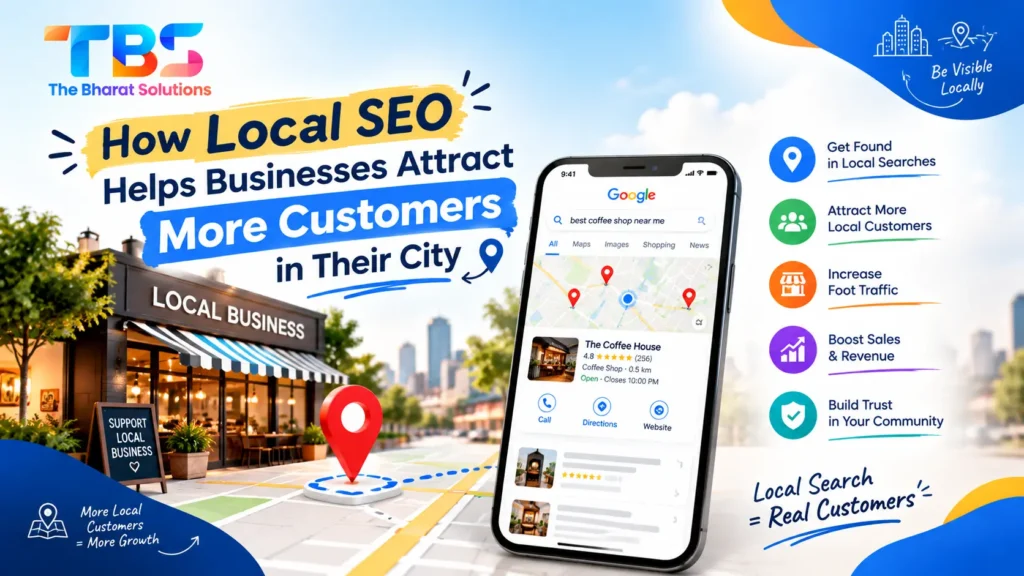
What Is Local SEO and How Is It Different from Traditional SEO?
It is the practice of making your business easier to find in searches tied to a location, such as “dentist near me” or “AC repair in Ahmedabad.” Google treats these as local search intent: the person wants something close by, so it shows a map, a short list of businesses and ordinary web results.
Traditional SEO tries to rank a website for broad topics, often for people anywhere in the country. Local search optimisation narrows the focus. It cares about where you are, how close you are to the searcher and how trustworthy your business looks in that area. A shop in Ahmedabad doesn’t need to rank in Mumbai. It needs to show up for people within a few kilometres.
The two overlap, because a fast, well written website helps both. But local business SEO leans on things traditional SEO barely touches: your Google Business Profile, reviews, map listings and the details of your business across the web.
Connecting with People Searching Nearby
The real power of local SEO is how close to a decision these searchers are. Someone searching “cafe near me” isn’t researching for a month. They’re hungry now. That kind of local search intent is why these searches often lead to calls, direction requests and walk-ins rather than just page views.
When your business appears in local search results, you reach nearby customers at the moment they’re ready to act. There’s no cold outreach and no guesswork. You just show up where they’re already looking. For many owners, that’s one of the most direct ways to attract local customers without depending only on paid ads.
The Building Blocks: Google Business Profile, Maps, Reviews, Keywords and Listings
Google Business Profile
Your Google Business Profile is the card that appears when someone searches for you or for a service you offer. It shows your name, address, phone number, hours, photos, services and reviews. A complete, accurate profile is probably the most useful local asset you can have, and Google Business Profile optimisation is where most businesses should start.
Fill in every section. Pick the right primary category. Add real photos of your premises and work. Post updates and offers, and answer the questions people ask. Keep hours current, especially around festivals and holidays, because nothing frustrates a customer like a closed door.
Regular business profile management matters too. A profile that was set up once and forgotten tends to fall behind one that someone actually looks after.
Google Maps
Google Maps visibility rests on three broad things: relevance (does your profile match what the person searched for?), distance (how close are you?) and prominence (how well known and trusted are you?). You can’t move your shop, but you can work on the other two.
Customer Reviews
Customer reviews do a lot of quiet work. They build trust with people who’ve never heard of you, and they give Google more to go on. Ask happy customers for an honest review, make it easy with a direct link, and reply to every one, good or bad. Never buy reviews or offer rewards for positive ones. Google’s rules are strict, and customers can usually tell.
Keywords That Match Local Searches
Your website should mention the areas you serve and the services you offer, in the words customers actually use. Location-based keywords such as “interior designer in Ahmedabad” or “physiotherapy clinic near CG Road” belong in page titles, headings, service pages and your profile description, written naturally, not crammed in.
Business Directory Listings and NAP Consistency
Business directory listings, from industry directories to local listing sites, help confirm that your business is real and where it is. What matters most is NAP consistency: your name, address and phone number should be written the same way everywhere. If one site says “Shop 4” and another says “Unit 4,” or an old phone number is still floating around, it confuses both customers and search engines.
Practical Strategies You Can Start With
You don’t need a big budget to begin. Here’s a sensible order of work for local SEO for small businesses:
- Claim and complete your Google Business Profile. Verify it, then fill in every field you can.
- Audit your listings. Search for your business name and phone number, then fix anything that doesn’t match.
- Build useful local pages. If you serve several areas, write a genuine page for each instead of copying the same text.
- Collect reviews steadily. A few new ones each month looks more natural than a sudden burst.
- Add local content. Write about area-specific questions and problems your customers actually have.
- Check your mobile site. Most local searches happen on phones, and slow pages lose people fast.
- Track what happens. Watch calls, direction requests and website visits so you know what’s working.
Do these consistently and you’ll be taking the steps many businesses use to improve local search rankings over time, though results depend on your market and competition. Some owners handle this themselves. Others bring in local SEO services to save time, particularly when managing several locations.
Common Mistakes and How to Avoid Them
Most local search optimisation problems are fixable. These are the ones that come up most often.
- Setting up the profile and walking away. Hours change, services change, offers expire. Check in regularly.
- Inconsistent business details. Different phone numbers or addresses across sites confuse everyone. Audit them and correct what doesn’t match.
- Ignoring reviews. Silence on a complaint looks worse than the complaint itself. A calm, helpful reply shows future customers how you handle problems.
- Stuffing keywords into your business name. Adding something like “Best Cheap AC Repair Ahmedabad” to the name field breaks Google’s guidelines and can get a profile suspended. Use your real business name.
- Chasing shortcuts. Fake reviews, duplicate listings and bought links might look clever for a week and cause trouble for years.
- Forgetting mobile. A slow or clumsy mobile site loses people quickly.
What Local Search Can Do for Traffic, Enquiries, Calls and Store Visits
A strong local presence can support several things at once: more website traffic from nearby searches, more calls straight from your profile, more direction requests and, for shops and clinics, more people walking in. It can also bring enquiries through your contact form or WhatsApp button. Better Google Maps visibility often shows up first as calls and direction requests, especially from nearby customers who are close enough to visit the same day.
That said, local SEO isn’t a switch you flip. Results vary by industry, competition, location and how much work goes in, and nobody can honestly guarantee rankings or a set number of customers. What it can do is make your business easier to find and easier to trust, which gives you a fair shot in the searches that matter.
How The Bharat Solutions Can Help
Doing all of this while running a business is a lot. The Bharat Solutions offers SEO and digital marketing services, including support for businesses that want to strengthen their local online presence.
If you’re looking for an SEO company in Ahmedabad or a local SEO agency in Ahmedabad, a good first step is a simple review of your current profile, listings, website and reviews. From there, local SEO services might include Google Business Profile optimisation, listing clean-up, planning around location-based keywords and content support, along with reporting so you can see what’s changing.
Because every business and neighbourhood is different, recommendations depend on your industry, competition and goals. Expectations stay realistic, with no promises of guaranteed rankings or customers.
Frequently Asked Questions
1. What is local SEO and who needs it?
It’s the work of helping a business show up when people search for products or services nearby. Any business with a physical location or a defined service area can benefit, from clinics and salons to repair shops and restaurants. Local SEO for small businesses is especially useful because it lets you compete in your own area without a national-sized budget.
2. How can I improve local search rankings on Google Maps?
Start with a complete, verified Google Business Profile and keep your name, address and phone number consistent everywhere. Choose accurate categories, collect genuine reviews and make sure your website clearly mentions the area you serve. Distance plays a part too, so what people see will vary depending on where they’re searching from. No one can guarantee a particular position.
3. Do I really need Google Business Profile optimisation?
If customers find businesses like yours by searching in your area, yes, it’s worth the effort. The profile is free to create, and it’s often the first thing people see. Complete details, fresh photos, accurate hours and regular updates make it more useful to customers and easier for Google to understand. It’s one of the simplest parts of business profile management.
4. How many customer reviews do I need?
There’s no magic number. What matters is that reviews are genuine, recent and spread over time, and that you respond to them. A steady trickle of honest feedback from real customers usually looks better than a sudden spike. Don’t pay for reviews or write fake ones.
5. How do I choose the right location-based keywords?
Think about how your customers describe what they need and where they are. Combine your service with your city, area or a known landmark, then look at how nearby competitors word their pages. Use those phrases naturally in headings, service pages and your profile description, and don’t repeat them just for the sake of it.